Guide to your knives
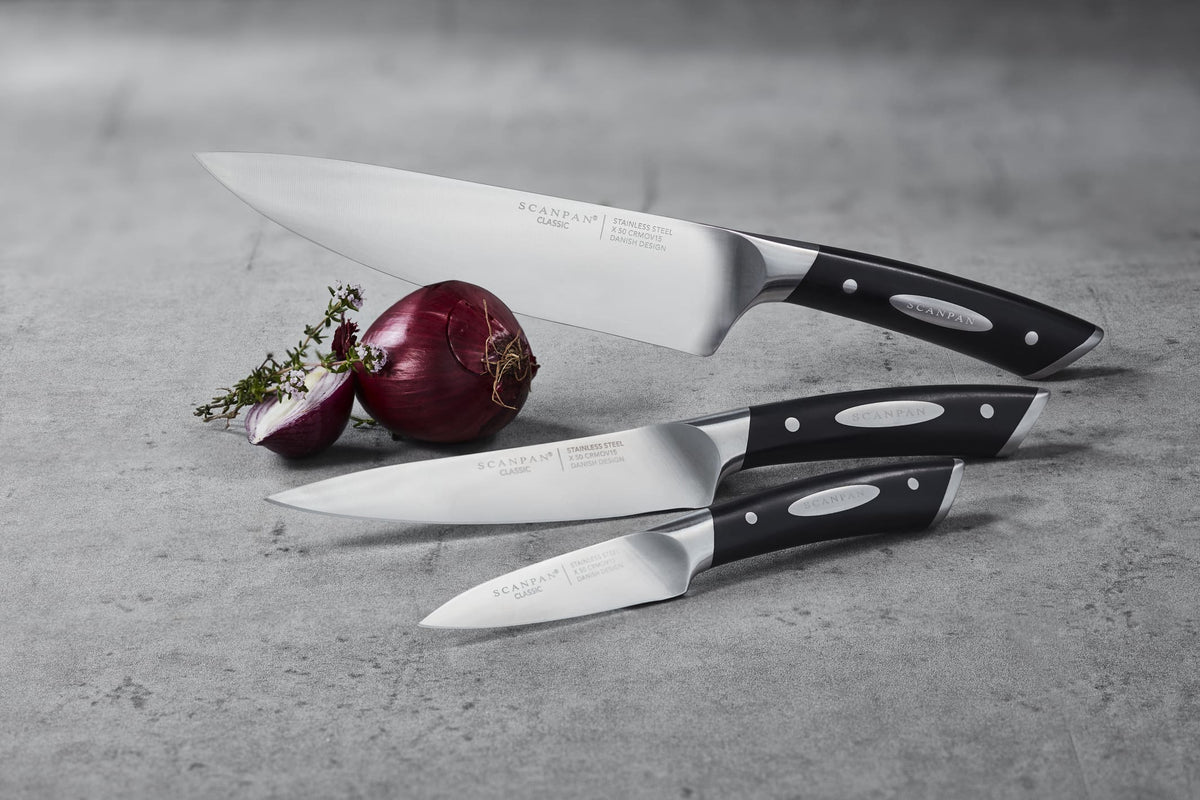
SCANPAN knives in brief:
- Made of the highest quality German stainless steel
- The blades are optimally tempered to hardness rating 56–57
- Superb weight distribution and balance
- Special grinding for optimum and enduring sharpness
- The ergonomic handles provide a comfortable and secure grip
Storage and maintenance of knives
Storing your knives
When you need a kitchen knife, do you open the kitchen drawer where they are stored together with other kitchen utensils? Are they hanging on a knife magnet? Or perhaps you keep them in a knife block?
If they are stored in the kitchen drawer, it is time to change your knife habits. You should never store sharp knives loosely in a drawer. It makes the blades dull and worn, and there is also a significant risk of cutting yourself when looking for a knife.
Always choose either a knife magnet or a knife block. This ensures that your knives are stored properly, both in terms of safety and their lifespan.
Honing steel or knife sharpener?
Honing steel:
A honing steel straightens the knife edge, removing small dents and deformations. It does not grind your knives or make them sharper than they were originally. Instead, it hones them. Hone your knives a few times a month.
Knife sharpener:
If your knives need to be sharper, use a knife sharpener or sharpening steel. This makes dull knives sharp again by removing a small amount of metal. How often they need sharpening depends on the quality of the knife, the type of steel and, of course, how often the knife is used. A good rule of thumb is to sharpen your knives once a month and hone them three to four times a month.
Cleaning & rust film
Cleaning
Never put your kitchen knives in the dishwasher!
Kitchen knives are dishwasher-safe, including SCANPAN knives. However, dishwasher salts and chemical substances wear down the steel of the blade and the sharp knife edge.
If you always wash your kitchen knives in the dishwasher, they will become dull faster and cut less effectively. They will therefore need to be sharpened more often, which causes further wear.
Wash your sharp knives by hand with warm water and dishwashing liquid. Dry them afterwards with a clean tea towel to avoid stains on the blade and handle.
Avoid rust film on your knives
Brown rust marks on expensive kitchen knives are frustrating. Rust film comes from kitchen utensils that contain iron, such as cheese slicers, garlic presses and egg slicers, and can settle on knives and other stainless steel equipment in the dishwasher.
Over time, rust film can develop into pitting corrosion if it is not removed from both the knife and the dishwasher.
Washing your kitchen knives by hand eliminates the risk of rust film on the knives.
Rust film on the knives can be removed with steel polish or steel cleaner.
Which knives should you use?
The different types and purposes of knives
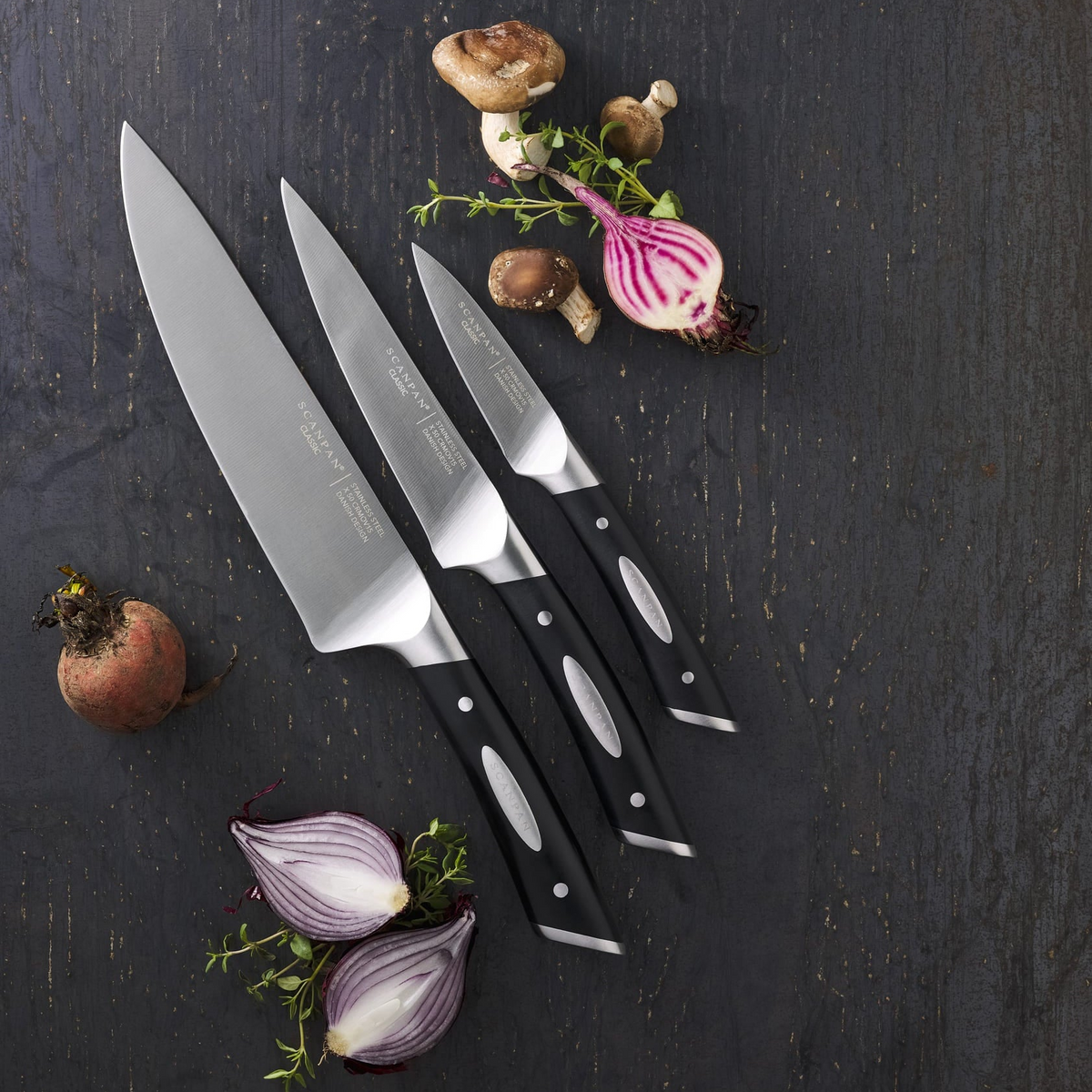
Are you looking for a complete set of kitchen knives, each designed for specific tasks? Or does it make more sense to start with the ‘holy trinity’ of meat, vegetables and bread, using a cook’s knife, a paring knife and a bread knife? Here is a quick guide.
Cook’s/meat knife:
A cook’s knife with a relatively large blade is a versatile tool for cutting raw meat, carving a roast and slicing vegetables. Pay attention to the height of the blade. A tall blade offers good mobility and room for your fingers.
Paring knife:
If you often slice and chop vegetables, a santoku knife is a good investment. Many santoku knives have grooves in the blade to help prevent vegetables from sticking, as well as a tall blade that gives a straight cut and is easy to control.
Bread knife:
A bread knife is useful for much more than cutting bread. A bread knife can also be used to chop nuts, chocolate and tomatoes because it grips the surface.
Material and ergonomics
Material:
SCANPAN knife blades are tempered to hardness rating HRC 56–57 and made from high-quality German stainless steel, which is typically associated with robust knives. Our special grinding provides excellent cutting properties. For the best possible ergonomics and hygiene, we use POM for our handles. This material fits tightly around the metal parts of the knife, resulting in a highly hygienic and easy-to-clean handle.
Ergonomics and grip:
Your kitchen knives should sit well in your hand and be comfortable and safe to use. SCANPAN has chosen a teardrop-shaped profile for the knives because it provides better control and handling while you work. The handle should follow the contours of your palm and sit naturally in a firm and secure grip, without making you feel that you need to squeeze hard to hold the knife safely in place.
Video guides
See our video guides to sharpening knives correctly.

3-step wet knife sharpener
With the SCANPAN 3-step wet knife sharpener, you can keep your knives sharp and useful for many years to come. See how here. The three steps have different levels of fineness, depending on how dull your knife is. Metal residue from sharpening can easily be rinsed off afterwards.

3-step dry knife sharpener
With the SCANPAN 3-step dry knife sharpener, you can keep your knives sharp and useful for many years to come. See how here. The three steps have different levels of fineness, depending on how dull your knife is. The knife sharpener is easy to clean with a damp cloth.

Diamond sharpening steel
This coarser diamond sharpening steel is designed to fully restore a dull knife edge and is therefore not intended for daily use. Use the honing steel below for daily maintenance.

Honing steel
Regular use of this honing steel will refine the knife edge so that it remains razor sharp. Frequent use will keep your knives perfectly sharp.